Lead reactivation · Field notes
Why “Are you still interested?” doesn't work, and how we got 2.5x more replies from “dead” leads
Sooner or later every developer opens the CRM and finds thousands of leads marked “lost.” Each one was paid for at some point. Some bought from a competitor, some changed their minds, and some are still looking for a home and simply stopped hearing back.
What we tried and why it didn't work
We've tried to win back databases like this many times, at different companies. We sent “Hi, are you still interested in buying a property?”, pushed promotions, ran surveys. A handful of people replied.
The most common message is also the most useless: “Are you still interested?” The person reads it as: here comes the sales pitch. If they're still looking, staying quiet is easier than explaining why they stopped answering six months ago. If they already bought, they have no reason to tell you.
Promotions and discounts only work on people who were ready to buy anyway and were waiting for an excuse. Everyone else sees a promotion with no context as one more blast. Frequent promotions also teach the database to wait for a discount instead of deciding.
Surveys like “rate our service from 1 to 10” behind a link get filled out by people who are bored, not by the people we need. Almost nobody will click a link and answer ten questions for someone else's benefit.
All three have the same problem: the message is about what the developer needs. The person has no reason to reply.
What worked: a WhatsApp message from the quality control team
The approach that worked best looked like a side project at first. We started messaging “lost” leads on WhatsApp on behalf of the quality control team. The person contacted the company at some point, a sales rep worked with them, and quality control wants to know how that went.
This is real quality control: the answers get reviewed with the sales team afterward. If you do it for show, people will feel the difference the next time you contact them.
Here's what the first message can look like:
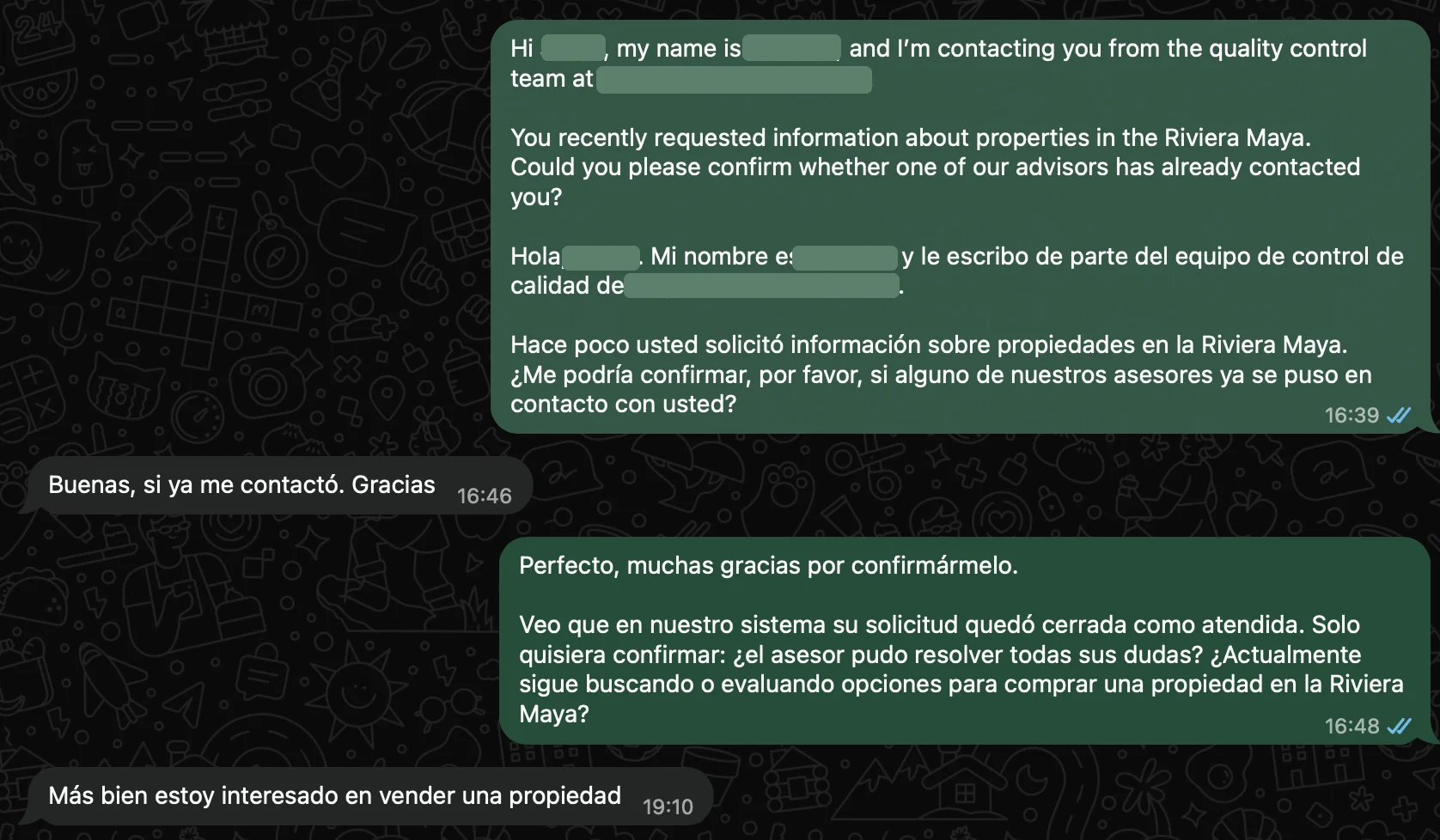
Hi Andrea, my name is Jorge and I'm writing from the quality control team at company X. In March you asked about our apartments. Could you tell us whether you got all the information you were looking for? Did our sales rep get in touch with you? Were they polite and professional?
And here's how it looks in a real conversation. Names and the company name are hidden.
Why people reply:
- The conversation is about them, not the purchase. They're asked about their own experience. It's an easy question and it commits them to nothing.
- They have a legitimate reason to complain. Many of them really never got a callback or the materials they were promised. They have something to say, and they say it.
- There's no pressure. Quality control isn't selling anything, and the person can tell.
One conversation does three jobs
After this message (we call the ones who don't reply), one of these situations usually comes up.
| What the person says | What it means | What we do |
|---|---|---|
| “Nobody ever called me back / sent me anything” and they're still looking | The lead didn't get lost. We lost it | We apologize, confirm budget and timing, and hand them to a sales rep the same day with context |
| “I already bought” | We lost, but we can find out why | We ask where they bought and what decided it: price, location, payment terms, response speed |
| “I want to sell my property first” | A future buyer whose money is tied up in another property | We refer them to a partner agency and stay in touch until it sells |
| “Not looking right now” / “I put it off” | A future purchase | We log the reason and agree on when to pick the conversation back up |
The other rows pay off too. Answers from people who bought from a competitor show exactly where the project loses to the market.
Sometimes “I already bought” is only the start of the conversation. One person replied that they already had an apartment. Then it turned out they wanted to sell another property they owned. We referred them to a partner agency, which helped with the sale, and with the proceeds they bought a unit from the developer.
Quality control gets covered along the way. After a hundred of these conversations you can see which reps don't call back, who doesn't send presentations, and at what stage clients most often go cold.
How to run it yourself
- Export the database. Leads with no activity for more than 30 days, including those closed as “lost.” Put phone numbers in +52 format, remove duplicates, and exclude anyone who asked not to be contacted.
- Don't give the survey to whoever handled the lead. If the same rep writes, you won't get an honest conversation about quality. You need a separate person, a separate team, or an AI agent.
- Prepare 4 or 5 questions, not a questionnaire: did someone call you back, and how fast; did you get prices, floor plans, and terms; are you still considering a purchase, at what budget and when; if you already bought, where, and what drove the choice.
- Set up CRM fields: survey result, complaint (about what), purchase status, reason for choosing a competitor. Without them, the data stays buried in chats.
- Hand live leads to sales the same day, along with what the person told you. The rep's first message opens with an apology for last time, not with a presentation.
- Review the answers with the sales team once a week. Otherwise it really does turn into a trick.
Where AI comes in
Running this survey by hand across a database of several thousand leads takes weeks, and after a couple of days people start going through the motions. An AI agent runs the same conversations on WhatsApp in parallel, asks everyone the same questions, and passes anyone still looking straight to a sales rep. Competitor data and complaints land in CRM fields instead of staying in chats.
Frequently asked questions
Isn't this deceiving the client?
Not if the quality control team actually exists and its findings get used. The questions are asked honestly, and the answers change how the sales team works. If the person is still looking for a home, they get help. If not, nobody bothers them again.
Why not message them from the sales rep directly?
People read a message from a salesperson as a pitch and stay quiet. They're more willing to answer a question about service quality, because it's about their experience and commits them to nothing.
What should I do with people who already bought from a competitor?
Ask where and why. It's free market research from people who went through the whole buying decision. No ad analytics will give you that data.
Call or message on WhatsApp?
Start with WhatsApp: in Mexico it's the main channel people use, and messages there got better responses. Call the ones who don't reply.